Description
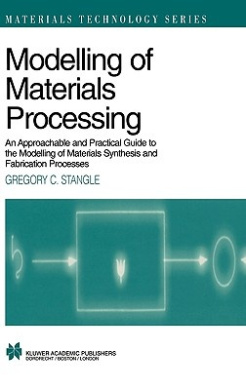
This is a book about mathematical modelling. It focuses on the modelling of the preparation of materials. Materials are important, of course, in an economic sense: the “goods” of goods-and-services are made of materials. This provides a strong incentive to produce good materials and to improve existing materials. Mathematical modelling can help in this regard. Without a doubt, modelling a materials processing operation is not strictly necessary. Materials synthesis and fabrication processes certainly existed before the invention of mathematics and computers, and well before the combined use of mathematics and computers. Modelling can, however, be of assistance–if done properly–and if used properly. The mathematical modelling described in this book is, at its root, a rather formal, structured way of thinking about materials synthesis and fabrication processes. It requires looking at a process as a whole. It requires considering everything that is or might be important. It requires translating the details of a given physical process into one or more mathematical equations. It requires knowing how to simplify the equations without over-simplifying them. Preface. Acknowledgments. Part 1: Balance equations. Balance equations: an informal description. Conserved quantities for the balance equations. Balances for a single-phase material. Balances for a multiphase material. Part 2: Constitutive relationships. Constitutive relationships: near-equilibrium thermodynamics. Expressions for a single-phase material. Internal geometry and topology of multiphase materials. Expressions for the system in a multiphase material. Expressions for the solid phase in a multiphase material. Expressions for the liquid phase in a multiphase material. Expressions for the vapor phase in a multiphase material. Part 3: Practical considerations. Interlude: use of chapters 1-11. Sources of material property values. Numerical solution: some finite difference methods. Numerical solution: some finite element methods. Part 4: Implementation. Example: glass refining. Example: Fiber spinning. Example: alloy solidification. Example: microwave heating of ceramics. Example: combustion synthesis of refractory materials. Example: binder removal from shaped powder compacts. Example: Flow of a solid-liquid suspension. Postface. References. Appendices. Notation. Index.