Description
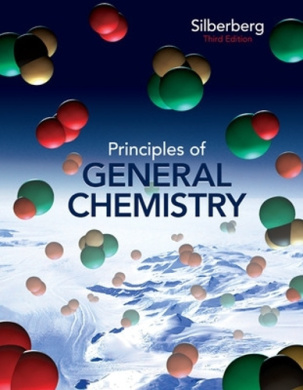
Silberberg’s Principles of General Chemistry offers students the same authoritative topic coverage as its parent text, Chemistry: The Molecular Nature of Matter and Change. The Principles text allows for succinct coverage of content with minimal emphasis on pedagogic learning aids. This more streamlined approach to learning appeals to today’s efficiency-minded, value-conscious instructors and students without sacrificing depth, clarity, or rigor. Martin S. Silberberg received his B.S. in chemistry from the City University of New York in 1966 and his Ph.D. in chemistry from the University of Oklahoma, in 1971. He then accepted a research position at the Albert Einstein College of Medicine, where he studied the chemical nature of neurotransmission and Parkinson’s disease. In 1977, Dr. Silberberg joined the faculty of Simon’s Rock College of Bard (Massachusetts), a liberal arts college known for its excellence in teaching small classes of highly motivated students. As Head of the Natural Sciences Major and Director of Premedical Studies, he taught courses in general chemistry, organic chemistry, biochemistry, and nonmajors chemistry. The close student contact afforded him insights into how students learn chemistry, where they have difficulties, and what strategies can help them succeed. In 1983, Dr. Silberberg decided to apply these insights in a broader context and established a text writing and editing company. Before writing his own text, he worked on chemistry, biochemistry, and physics texts for several major college publishers. He resides with his wife and child in Massachusetts. For relaxation, he cooks, sings, and walks in the woods. 1 Keys to the Study of Chemistry2 The Components of Matter3 Stoichiometry of Formulas and Equations4 Three Major Classes of Chemical Reactions5 Gases and the Kinetic-Molecular Theory 6 Thermochemistry: Energy Flow and Chemical Change7 Quantum Theory and Atomic Structure8 Electron Configuration and Chemical Periodicity9 Models of Chemical Bonding10 The Shapes of Molecules11 Theories of Covalent Bonding12 Intermolecular Forces: Liquids, Solids, and Phase Changes13 The Properties of Mixtures: Solutions and Colloids14 The Main-Group Elements: Applying Principles of Bonding and Structure15 Organic Compounds and the Atomic Properties of Carbon16 Kinetics: Rates and Mechanisms of Chemical Reactions17 Equilibrium: The Extent of Chemical Reactions18 Acid-Base Equilibria19 Ionic Equilibria in Aqueous Systems20 Thermodynamics: Entropy, Free Energy, and the Direction of Chemical Reactions21 Electrochemistry: Chemical Change and Electrical Work22 The Transition Elements and their Coordination Compounds23 Nuclear Reactions and their Applications