Description
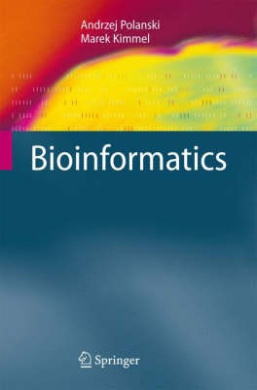
This textbook presents mathematical models in bioinformatics and describes biological problems that inspire the computer science tools used to manage the enormous data sets involved. The first part of the book covers mathematical and computational methods, with practical applications presented in the second part. The mathematical presentation avoids unnecessary formalism, while remaining clear and precise. The book closes with a thorough bibliography, reaching from classic research results to very recent findings. This volume is suited for a senior undergraduate or graduate course on bioinformatics, with a strong focus on mathematical and computer science background. Andrzej Polanski received M.Sc., Ph.D. and D.Sc. (habilitation) degrees in control engineering respectively in 1982, 1991 and 2000 all from the Department of Automatic Control, Silesian University of Technology in Gliwice. He we working as a Post Doctoral Fellow at the University of Texas, Human Genetics Center, Houston USA (1996-1997) ans as a Visiting Professor at Rice University, Houston USA (2001-2003). He is currently a Professor at the Silesian University of Technology. His research interests are in bioinformatics, biomedical modeling and control, modern control and optimization theory. Marek Kimmel, Ph.D., is a Professor of Statistics at Rice University in Houston, TX, Professor in Department of Automatic Control, Silesian University of Technology in Gliwice, Poland, Professor of Biostatistics and Applied Mathematics (adj.) at M.D. Anderson Cancer Center in Houston, and a Professor of Biometry (adj.) at the School of Public Health of the University of Texas in Houston. He is the Associate Chair of the Department of Statistics and is heading the Rice Bioinformatics Group as well as the doctoral program in Statistical Genetics and Bioinformatics. In 1980 he received a doctoral degree from the Silesian Technical University in Gliwice, Poland, and in 1997 a habilitation in Mathematical Sciences from the Jagiellonian University (est. 1364) in Krakow, Poland. His postdoctoral training took place in Memorial Sloan-Kettering Cancer Center in New York, NY. Dr. Kimmel is a Fellow of the American Statistical Association. His principal interests are stochastic modeling of human disease (in particular lung cancer progression and screening), statistical and population genetics, biostatistics and bioinformatics. Dr. Kimmel is a member of editorial boards of Journal of the National Cancer Institute, Journal of Theoretical Biology, Mathematical Biosciences and Journal of Biological Systems. He published a monograph (jointly with David Axelrod) “Branching Processes in Biology” (Springer 2002) and co-edited several volumes of papers in mathematical biology and biostatistics. He co-authored two statistical genetics software packages, GENOCHECK and CASPAR, available for the NCBI website. Dr. Kimmel has advised around 20 Ph.D. and M.S. students in United States, Poland and France. He organized numerous international meetings, schools and conferences, including the conferences on Mathematical Population Dynamics, started in 1987. His research has been supported by grants from the NIH (NCI), NSF, NATO and KBN (the Polish Committee for Scientific Research). Dr. Kimmel has a wide experience in data analysis and statistical computation, he taught graduate-level courses on survival analysis, modeling with stochastic processes, statistical process control and bioinformatics.