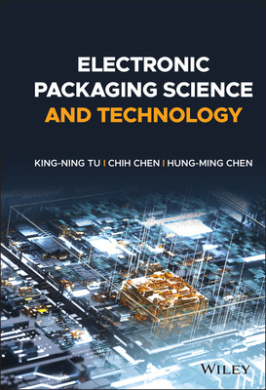
Description
King-Ning Tu, PhD, is TSMC Chair Professor at the National Chiao Tung University in Taiwan. He received his doctorate in Applied Physics from Harvard University in 1968. Chih Chen, PhD, is Chairman and Distinguished Professor in the Department of Materials Science and Engineering at National Yang Ming Chiao Tung University in Taiwan. He received his doctorate in Materials Science from the University of California at Los Angeles in 1999. Hung-Ming Chen, PhD, is Professor in the Institute of Electronics at National Yang Ming Chiao Tung University in Taiwan. He received his doctorate in Computer Sciences from the University of Texas at Austin in 2003. Preface Chapter 1 Introduction 1.1 Introduction 1.2 Impact of Moore’s law on Si technology 1.3 5G technology and AI applications 1.4 3D IC packaging technology 1.5 Reliability science and engineering 1.6 The future of electronic packaging technology 1.7 Outline of the book References Figures Caption Part I (Chapter 2 to Chapter 5) Chapter 2 Cu-to-Cu and Other Bonding Technologies in Electronic Packaging 2.1 Introduction 2.2 Wire bonding 2.3 Tape automated bonding 2.4 Flip chip solder joint bonding 2.5 Micro-bump bonding 2.6 Cu-to-Cu direct bonding 2.6.1 Critical factors for Cu-to-Cu bonding 2.6.2 Analysis of Cu-to-Cu bonding mechanism 2.6.3 Microstructures at the Cu-to-Cu bonding interface 2.7 Hybrid bonding 2.8 Reliability – Electromigration and temperature cycling tests References Figures Caption Problem Chapter 3 Randomly Oriented and (111) Uni-directionally Oriented Nanotwin Copper 3.1 Introduction 3.2 Formation mechanism of nanotwin Cu 3.3 In-situ measurement of stress evolution during nano-twin deposition 3.4 Electrodeposition of randomly-oriented nanotwin copper 3.5 Formation of uni-directionally (111)-oriented and nanotwin copper 3.6 Grain growth of [111] oriented nt-Cu 3.7 Uni-directional growth of eta-Cu6Sn5 in microbumps on [111] oriented nt-Cu 3.8 Low thermal-budget Cu-to-Cu bonding using [111]-oriented nt-Cu 3.9 Nanotwin Cu redistribution layer for fanout package and 3D integration References Figures Caption Problems Chapter 4 Solid-Liquid Interfacial Diffusion Reactions (SLID) between Copper and Solder 4.1 Introduction 4.2 Kinetic consideration of scallop-type growth in SLID 4.3 A simple model for the growth of mono-size hemispheres 4.4 Theory of flux-driven ripening 4.5 Measurement of the nano-channel width between two scallops 4.6 Extremely rapid grain growth in scallop-type Cu6Sn5 in SLID References Figures Caption Problems Chapter 5 Solid State Reactions between Solder and Copper 5.1 Introduction 5.2 Layer-type growth of IMC in solid state reaction 5.3 Wagner diffusivity 5.4 Kirkendall void formation in Cu3Sn 5.5 Side wall reaction to form porous Cu3Sn in micro-bumps 5.6 Effect of surface diffusion on IMC formation in pillar-type micro-bumps References Figures Caption Problems Part II (Chapter 6 to Chapter 8) Chapter 6 Essence of Integrated Circuits and Packaging Design 6.1 Introduction 6.2 Transistor and Interconnect Scaling 6.3 Circuit Design and Large Scale Integration 6.4 System-on-Chip (SoC) and Multi-core Architectures 6.5 System-in-Package (SiP) and Package Technology Evolution 6.6 3D IC Integration and 3D Silicon Integration 6.7 Heterogeneous Integration: An Introduction References Figures Caption Problems Chapter 7 Performance, Power, Thermal and Reliability 7.1 Introduction 7.2 Transistors and Memories Basics 7.3 Performance: A Race in Early IC Design 7.4 Trending in Low Power 7.5 Tradeoff between Performance and Power 7.6 Power Delivery and Clock Distribution Networks 7.7 Low Power Design Architectures 7.8 Thermal Problems in IC and Package 7.9 Signal and Power Integrity (SI/PI) 7.10 Robustness: Reliability and Variability References Figures Caption Problems Chapter 8 2.5D/3D System-in-Packaging Integration 8.1 Introduction 8.2 2.5D IC: Redistribution Layer (RDL) and TSV-Interposer 8.3 2.5D IC: Silicon, Glass, and Organic Substrates 8.4 2.5D IC: HBM on Silicon Interposer 8.5 3D IC: Memory Bandwidth Challenge for High Performance Computing 8.6 3D IC: Electrical and Thermal TSVs 8.7 3D IC: 3D-stacked Memory and Integrated Memory Controller 8.8 Innovative Packaging for Modern Chips/Chiplets 8.9 Power Distribution for 3D IC Integration 8.10 Challenge and Trend References Figures Caption Problems Part III (Chapter 9 to Chapter 14) Chapter 9 Irreversible Processes in Electronic Packaging Technology 9.1 Introduction 9.2 Flow in open systems 9.3 Entropy production 9.3.1 Electrical conduction 9.3.1.1 Joule heating 9.3.2 Atomic diffusion 9.3.3 Heat conduction 9.3.4 Temperature is a variable 9.4 Cross-effects in irreversible processes 9.5 Cross-effect between atomic diffusion and electrical conduction 9.5.1 Electromigration and stress-migration in Al strips 9.6 Cross-effect between atomic diffusion and heat conduction 9.6.1 Thermomigration in unpowered flip chip solder joints 9.7 Cross-effect between heat conduction and electrical conduction 9.7.1 Seebeck effect 9.7.2 Peltier effect References Figures Caption Problems Chapter 10 Electromigration 10.1 Introduction 10.2 To compare the parameters in atomic diffusion and electrical conduction 10.3 Basic of electromigration 10.3.1 Electron wind force 10.3.2 Calculation of the effective charge number 10.3.3 Atomic flux divergence 10.3.4 Back stress in electromigration 10.4 Current crowding and electromigration in 3-dimensional circuits 10.4.1 Void formation in the low current density region 10.4.2 Current density gradient force in electromigration 10.4.3 Current crowding induced pancake-type void formation in solder joints 10.5 Joule heating and heat dissipation 10.5.1 Joule heating and electromigration 10.5.2 Joule heating on mean-time-to-failure in electromigration References Figures Caption Problems Chapter 11 Thermomigration 11.1 Introduction 11.2 Driving force of thermomigration 11.3 Analysis of heat of transport, Q* 11.4 Thermomigration due to heat transfer between neighboring pairs of powered and unpowered solder joints References Figures Caption Problems Chapter 12 Stress-Migration 12.1 Introduction 12.2 Chemical potential in a stressed solid 12.3 Stoney’s equation of biaxial stress in thin films 12.4 Diffusional creep 12.5 Spontaneous Sn whisker growth 12.5.1 Morphology 12.5.2 Driving force 12.5.3 Kinetics of spontaneous Sn whisker growth 12.5.4 Electromigration induced Sn whisker growth in solder join 12.6 Comparison of driving forces among electromigration, thermomigration, and stress-migration 12.6.1 Products of force References Figures Caption Problems Chapter 13 Failure Analysis 13.1 Introduction 13.2 Microstructure change with and without lattice shift 13.3 Statistical analysis of failure 13.3.1 Black’s equation of MTTF for electromigration 13.3.2 Weibull distribution function and JMA theory of phase transformations 13.4 A unified model of MTTF for electromigration, thermomigration, and stress-migration 13.4.1 Revisit of Black’s equation of MTTF for electromigration 13.4.2 MTTF for thermomigration 13.4.3 MTTF for stress-migration 13.4.4 The link among MTTF for electromigration, thermomigration, and stress-migration 13.4.5 MTTF equations for any other irreversible processes in open systems 13.5 Failure analysis in mobile technology 13.5.1 Joule heating enhanced electromigration failure of weak-link in 2.5D IC technology 13.5.2 Joule heating induced thermomigration failure due to thermal crosstalk in 2.5D IC technology References Figures Caption Problems Chapter 14 Artificial Intelligence on Electronic Packaging Reliability 14.1 Introduction 14.2 To change time-dependent event to time-independent event 14.3 To deduce MTTF from mean microstructure change to failure 14.4 Summary